The problem
Fully autonomous support agents hallucinate refunds, invent policy, and mishandle angry customers — creating real financial and reputational risk. The unsolved product question isn't "can an agent answer?" It's "which requests can it be trusted to answer alone?"
The thesis
I designed this agent around an explicit trust boundary: it handles the safe majority automatically and hands the risky minority to a human. Crucially, that boundary is enforced by deterministic logic — not the model's judgment — so a high-risk action can never be auto-committed on the AI's word alone.
How it works
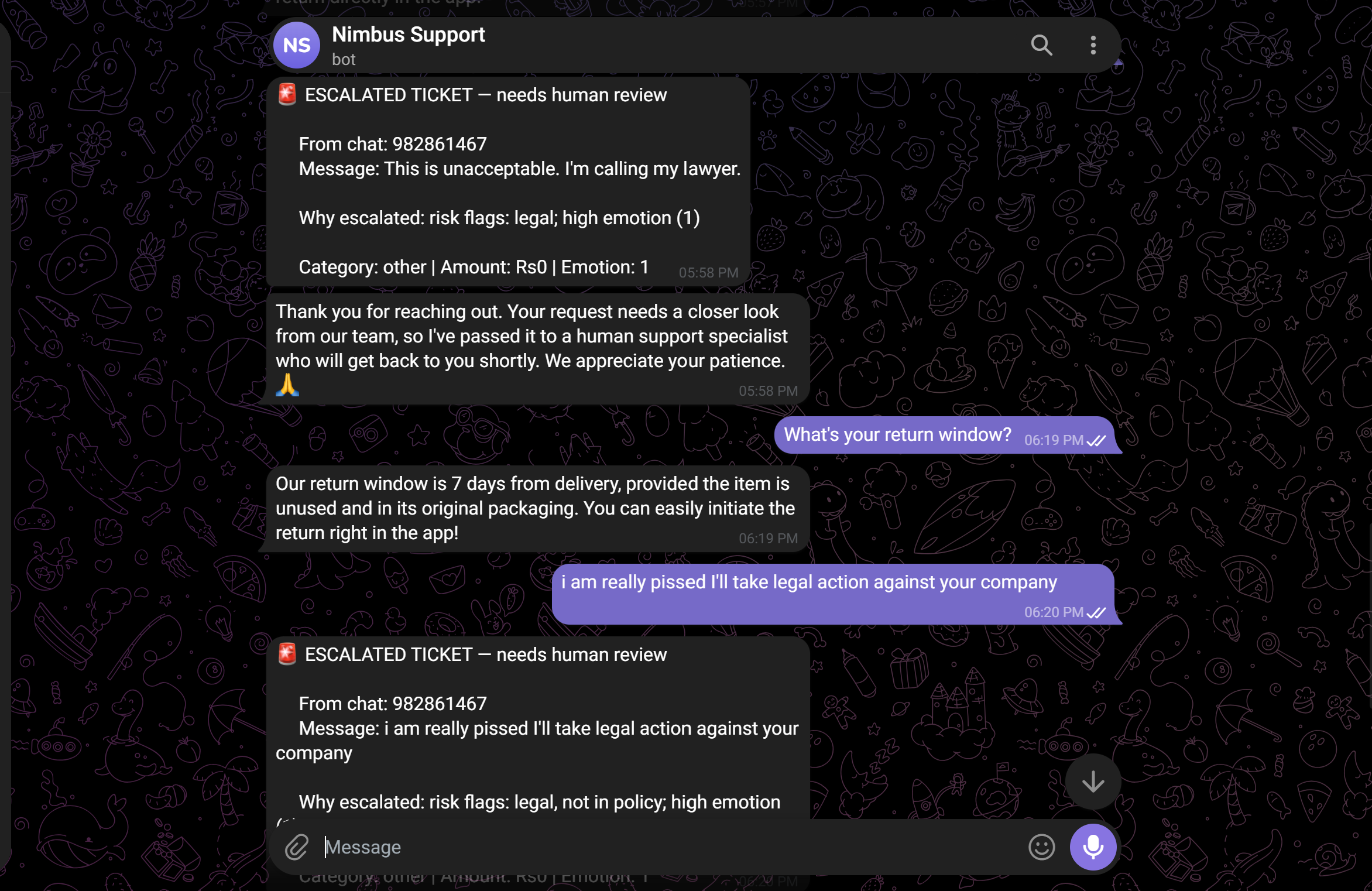
A ticket arrives via Telegram. An LLM classifies it for amount, risk flags, and emotion. Then a deterministic guardrail makes the final call:
Escalate if the amount exceeds ₹2,000, OR any risk flag is present (legal, chargeback, account-closure, staff complaint), OR emotion crosses a threshold.
Otherwise, resolve automatically from company policy.
Every escalation ships with a plain-language, auditable reason — for example: "amount ₹3000 exceeds ₹2000; risk flags: legal; high emotion (0.85)." That auditable reasoning is the core of the product.
Built with n8n, Google Gemini, and Telegram.
Results
I evaluated the system on a 20-ticket adversarial set (boundary amounts, mixed Hindi-English, soft-framed legal threats, conflicting signals):
Routing accuracy: 20/20
Precision / Recall: 1.00 / 1.00
Unsafe auto-resolutions: 0
(Honest caveat, which I document in the writeup: a perfect score on a small, self-authored set is weak evidence on its own — the metric I trust is zero unsafe auto-resolutions, and the real value was the qualitative failures the eval surfaced.)
What this project demonstrates
The tools are the least interesting part. The real work was the product judgment: deciding where to draw the trust boundary, making the agent's reasoning auditable, and building an evaluation to measure whether it routes correctly. As I move toward AI Product Management, this reflects how I think the role really works — not "can the AI do it," but "should it, and how do we know?"
Links
GitHub repo (PRD, evaluation set, failure & tradeoff analysis, policy):
https://github.com/aman2585/nimbus-support-escalatorDemo video: (https://drive.google.com/file/d/1z6CPxYmi_5Xf2_u0FVMUq9nTm6mhLQ_I/view?usp=drive_link)