The problem I set out to solve
Think about your parents or grandparents. They spend hours a day on WhatsApp — texting, sending voice notes, forwarding good-morning messages. They're completely at home there.
But ask them to order groceries on an app like Instamart or Blinkit, and it's a different story. Small fonts, layered menus, search bars, filters, product variants, unfamiliar payment screens. For a lot of older people, that's a wall.
And it's not just a hunch. Surveys of Indian seniors find that a majority feel digital tools are confusing — and they cite app navigation, not the idea of shopping online, as the primary reason. This group is highly active in messaging apps, but tends to avoid shopping and payment apps. The result is a painful irony: the people who would benefit most from grocery delivery are often the least able to use it themselves, so they end up relying on a family member to order for them.
The insight
So I asked a simple product question: what if ordering groceries could be as easy as sending a voice note, in your own language, on an app you already use every day?
That's PantryPilot. Instead of asking people to learn a new app, it meets them where they already are — a chat app — in the way that's most natural to them, speaking, and does the hard part of navigating the store for them.
Who it's for
The primary user is an older adult who uses WhatsApp or Telegram daily, is comfortable sending voice notes, but finds shopping apps and payment flows intimidating. They want to order groceries themselves, without having to ask their children every time. This is as much about dignity and independence as it is about convenience.
It also helps anyone who'd rather talk than tap — busy people, hands-free moments, anyone who finds speaking a quick list faster than navigating a store.
A note on scope: I'm not claiming voice replaces grocery apps for everyone. For an app-fluent user, the Swiggy app is faster. The point is that for a segment currently locked out by app-first design, the right interface changes everything.
What it does
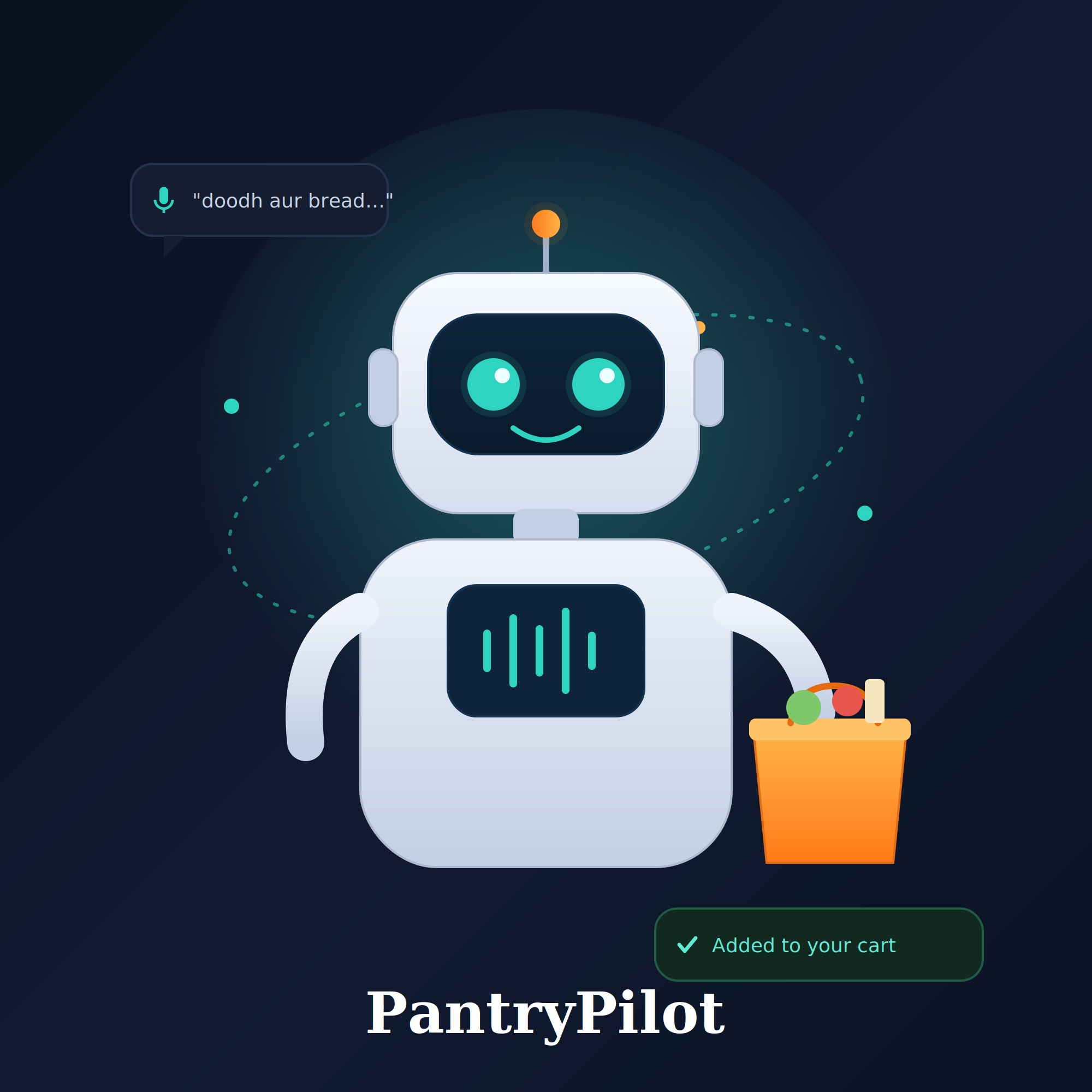
You send a voice note or text, in English, Hindi, Hinglish, or Tamil — for example, "do packet doodh, ek bread, aur paneer." PantryPilot understands the request, pulls out the grocery items, translates them into standard product names (so "doodh" becomes "milk"), searches Swiggy Instamart's real catalogue, picks a sensible product for each item while skipping ads and bulk packs, adds everything to your real cart, and sends back a clear confirmation of what it added and what it couldn't find. Then you review the cart and check out yourself.
How it works
At a high level, PantryPilot is an AI agent built as an automation workflow. The interface is Telegram, where the user can speak or type. Speech-to-text (Whisper) handles multiple Indian languages. Two LLM steps do the thinking — one interprets the request, one picks the best product. Swiggy's official MCP server is the doorway that lets the agent use Swiggy's live search and cart, not a mock. And n8n orchestrates the whole pipeline. (MCP, or Model Context Protocol, is an open standard that lets an AI agent use an app's real tools.)
The decisions I'm most proud of
Fill the cart, but never check out. The agent adds items but never pays or places the order — the person always reviews and checks out themselves. This is deliberate: research shows payments are exactly where older users lose trust. Keeping a human in control of the money makes the agent feel safe, not scared.
Shop like a thoughtful person. When several products match "milk," the agent doesn't grab the first result. It skips sponsored products, avoids strange bulk packs, and picks a sensible everyday option — the way a careful human shopper would.
Speak any language; keep search reliable. People talk naturally — "do packet doodh aur cheeni." The agent understands the mixed language and normalizes item names to English internally, so search stays accurate without asking the user to change how they speak.
Be honest when it can't help. If something's unavailable, it says so — "Couldn't find: squid" — instead of silently dropping it or adding the wrong thing. And if a message contains no groceries at all, it gently asks for a proper list rather than failing silently.
Telegram to prototype, WhatsApp to scale. I built on Telegram because its bot platform is free and instant — no fees, no approval — which is ideal for proving an idea fast. The same concept extends naturally to WhatsApp, where the real users already are. A classic build-fast-then-scale trade-off.
What I'd do next
Make it fully hands-off for always-on use, add stricter product matching to avoid loosely related substitutes, handle store-closed and expired-access cases gracefully, and extend to WhatsApp to reach the primary user segment at scale.
The takeaway
For a whole group of people locked out by app-first design, the right interface — voice, in their own language, on an app they already trust — can quietly bring them into modern convenience. This working agent is my proof that the idea holds.
Full write-up, PRD, and architecture on GitHub: https://github.com/aman2585/pantrypilot