The Brief
Milestone 2 established the real barrier: users avoid voice input not from lack of awareness, but from social discomfort and Hinglish-transcription distrust. Milestone 3's job was to design an actual solution — not just recommend one, but prototype it.
Three Directions, One Scored Decision
Considered three approaches, each attacking the discomfort barrier differently: whisper/low-volume capture, silent voice-to-text with review-before-send, and a contextual "safe-to-speak" nudge. Scored all three on Impact, Effort, and Confidence rather than picking by instinct.
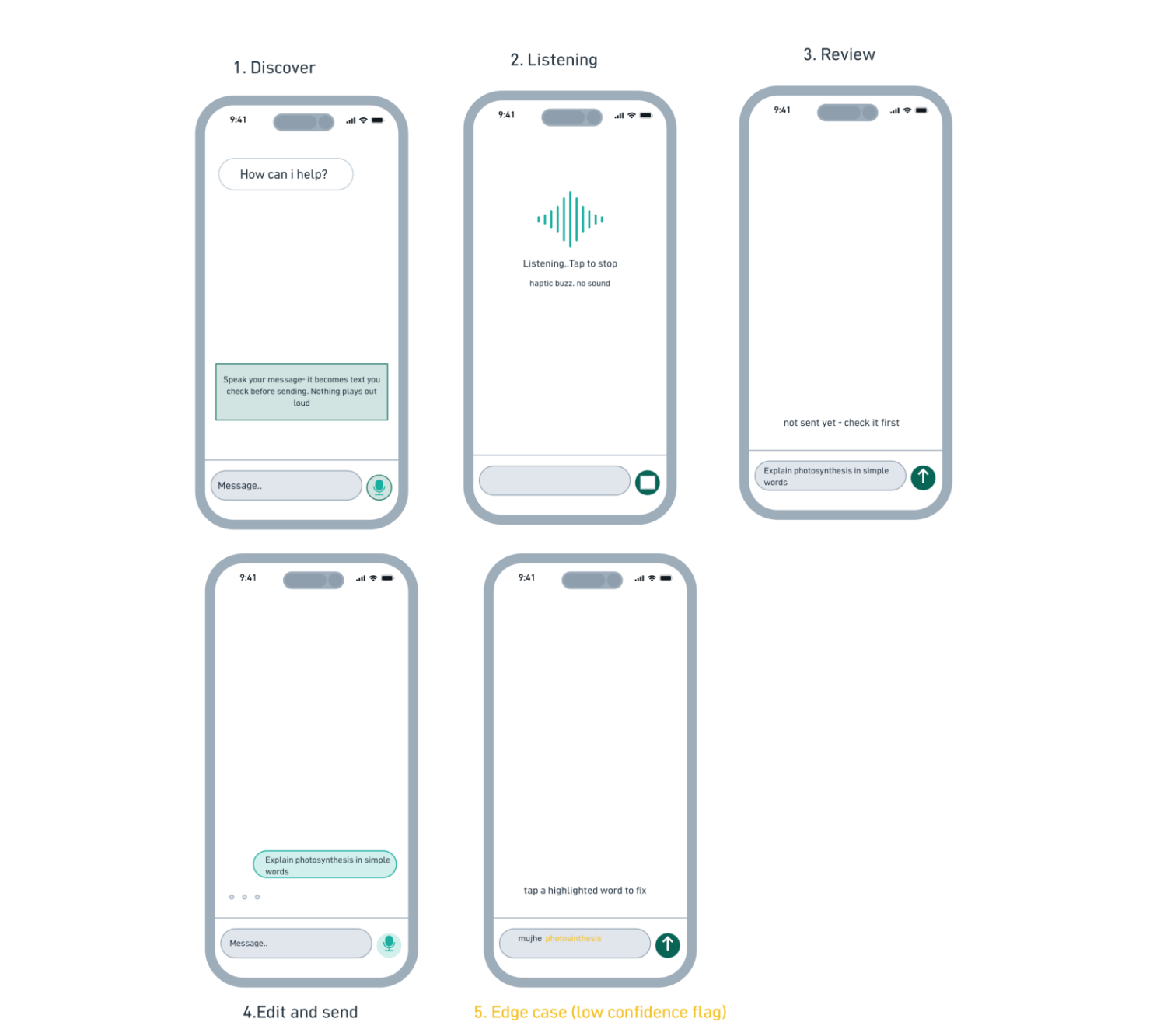
The safer, lower-risk option won — Silent Voice-to-Text with Review-Before-Send scored highest (4.67/5), beating the more ambitious whisper-mode idea (3.33/5) on execution certainty rather than raw ambition. The core mechanic: speech transcribes into the text field, but nothing sends and nothing plays aloud until the user deliberately taps send. To anyone nearby, it looks identical to normal texting.
From Flow to Screens to Working Prototype
Mapped the full discover-to-send user journey, explicitly flagging four unresolved edge cases (permission denied, no speech detected, low-confidence transcription, interrupted capture) rather than only designing the happy path. Built annotated wireframes for five screens — including a dedicated edge-case screen for flagging uncertain Hinglish words — then turned the design into a live, clickable AI-assisted prototype.
Defining Success Before Building
Set functional metrics (voice trial rate among users who'd never tried it, review-to-send completion rate, 7-day repeat usage) and non-functional metrics (transcription latency, Hinglish word-error rate), each with a stated baseline and target — plus an A/B experimentation plan with an explicit decision rule for what happens if trial rate comes in low but completion rate holds.
Try It
The prototype is live: [silent-voice-chat.lovable.app](https://silent-voice-chat.lovable.app/)
Honest Footnote
The scoring weights behind the solution selection are structured judgment calls, not measured data — stated plainly in the PRD rather than dressed up as precision. And one open loop carries over from Milestone 2: the planned user interviews were never conducted, so one hypothesis about users' mental model of the app still rests on partial evidence going into any future iteration.