The Brief
Milestone 1 framed voice non-adoption as a UX discoverability problem — a hard-to-find mic icon buried in a friction-heavy funnel. Milestone 2's job was to stop theorizing and test that assumption with real users: pick one high-impact segment, form hypotheses, and validate them with primary research.
Segment Selection
Laid out five candidate ChatGPT-mobile segments — students, job seekers, regional-language/Tier 2–3 users, content creators, and technical professionals — and scored them on a weighted framework (size, voice-task fit, adoption gap, business value, research feasibility). Regional-language users in Tier 2–3 cities scored highest, driven by the biggest gap between stated voice preference and actual ChatGPT usage. Scoped the final target to regional-language-first students and early-career professionals, keeping the impact rationale while staying reachable within a 2-week research window.
Hypotheses
Formed six falsifiable hypotheses on why this segment avoids voice input — spanning social discomfort speaking aloud, distrust in Hinglish transcription accuracy, lack of awareness (carried over from Milestone 1), ChatGPT's "typing tool" mental model, typing feeling more "serious," and assumptions about data/speed cost.
Research
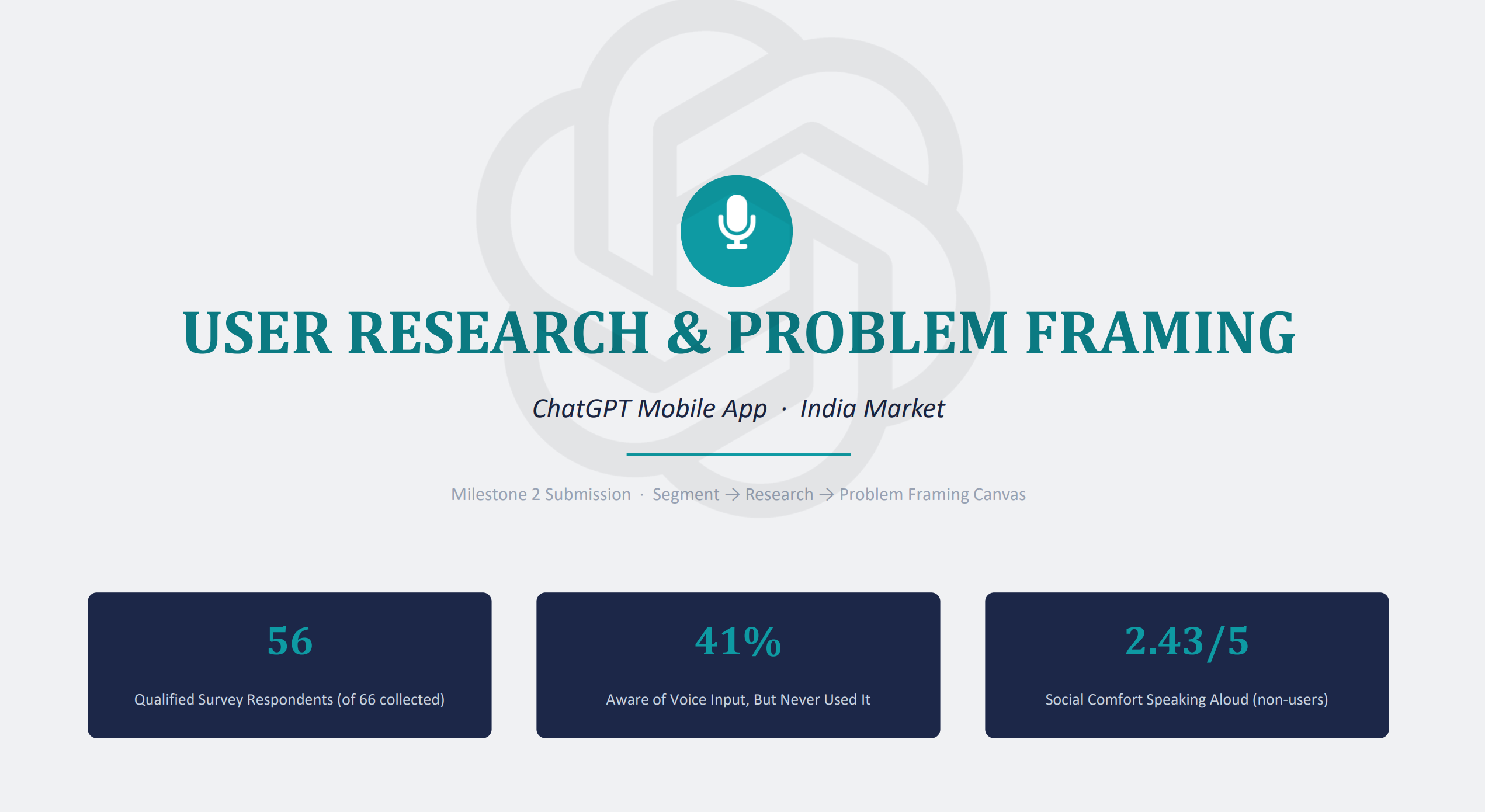
Designed and fielded a 13-question screened survey across Tier 2–3 cities, collecting 66 responses (56 qualified against the segment definition, 86% matching the target profile).
The Findings — A Reversal
Splitting respondents into those who knew voice input existed but never used it versus active users revealed a clear pattern: both groups looked nearly identical on mic findability and on believing "typing feels more serious." But they diverged sharply on comfort speaking aloud in front of others and trust that the app would understand Hinglish speech — non-users scored meaningfully lower on both.
Awareness wasn't the problem — 98% of respondents already knew the mic existed. The real barrier was confidence: people avoided voice because they didn't trust themselves to be overheard, or trust the app to understand mixed-language speech — not because they couldn't find the feature. Milestone 1's discoverability assumption didn't hold up.
(Full calculations and question-by-question data in the attached PDF.)
Problem Framing Canvas
The true problem: regional-language-first users avoid voice input not from lack of awareness, but from low confidence — social discomfort and Hinglish-transcription distrust — despite real-world accuracy being reasonably good when actually tried. This matters now because competitors have already normalized voice in India, and the fix is a confidence/UX problem, not a costly capability rebuild.
The Takeaway
Not a discovery problem. A confidence problem. Users can already find the mic — they just don't trust themselves, or the model, enough to use it.
Honest Footnotes
The planned 5–6 qualitative interviews are still pending, so the mental-model hypothesis has partial, not full, support. And the segment-scoring weights that drove this research direction were structured estimates, not sourced metrics — a prioritization tool designed to be tested, which is exactly what this milestone did.