The Problem
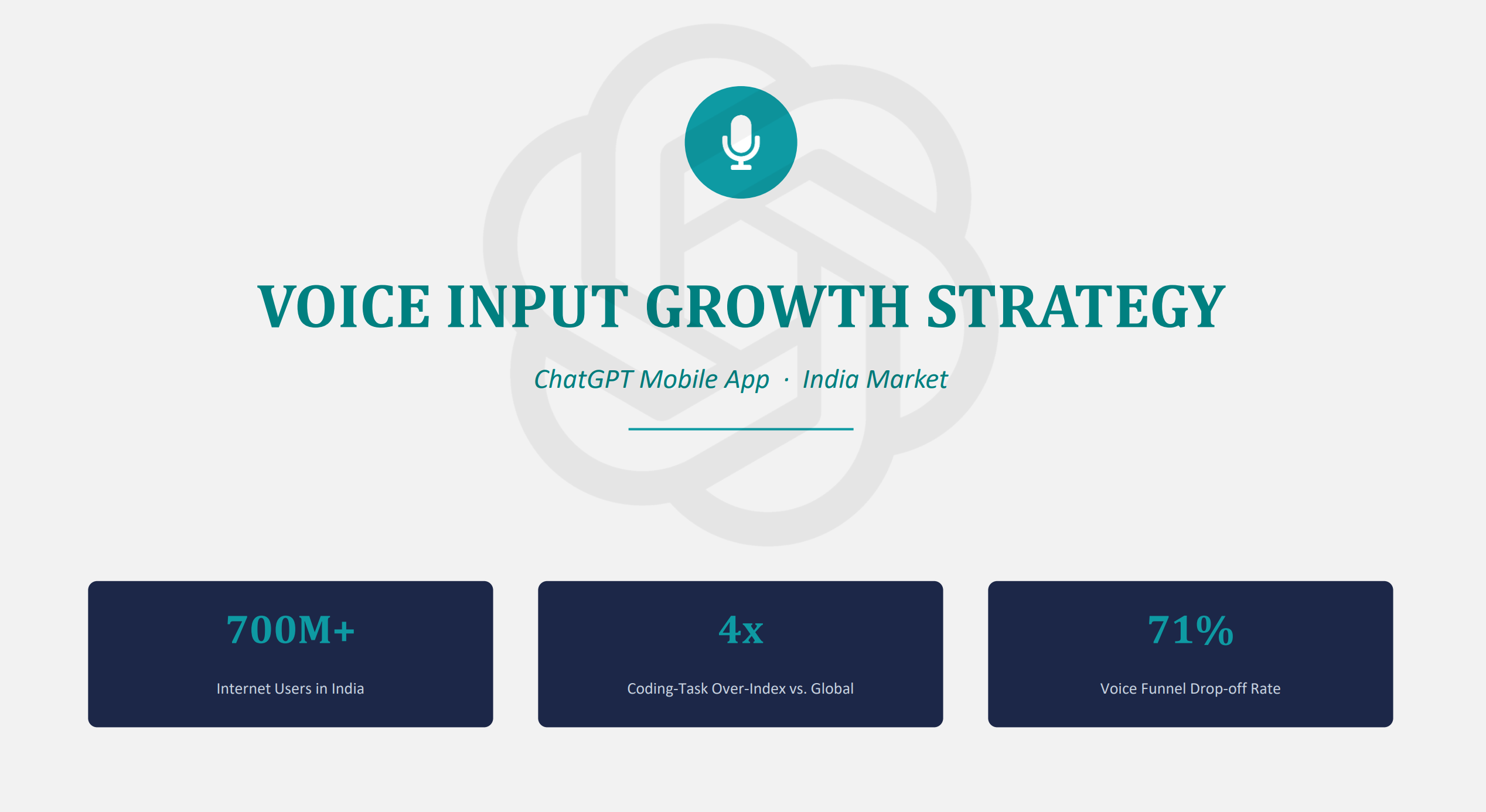
India has 700M+ internet users, 95% mobile-first, spread across 22 official languages and 19,500+ dialects. Voice is the default input behavior on every major platform — WhatsApp (45% send voice notes daily), YouTube (70% voice search), Google Assistant (60% voice queries), Google Maps (55% voice navigation). Yet on ChatGPT mobile, voice input adoption is near zero.
The question Milestone 1 set out to answer: is this a capability gap or a behavior gap?
What I Built
1. Market Landscape. Benchmarked voice usage rates across five platforms and mapped the three structural drivers of voice-first behavior in India: linguistic diversity (68% of local-language users prefer voice over regional keyboards), the accessibility dividend (1-in-3 visually impaired users rely on voice assistants weekly), and the Hinglish-by-default reality (90%+ of enterprise voice platforms run Hindi-English code-switching pipelines).
2. The Utility Bias Paradox. Indian ChatGPT users over-index 4x on data analysis and 3x on coding vs. global medians — precision-typing tasks that anchor a "ChatGPT = keyboard tool" mental model before voice-appropriate use cases are ever discovered. The insight: the same complexity that makes ChatGPT valuable in India is what's training users to never speak to it.
3. UX Funnel Friction Audit. Mapped a 7-stage user journey with a 71% cumulative drop-off concentrated in 5 stages — from a 45MB+ APK install barrier through a low-contrast mic icon, multi-tap activation, long-form voice readback, and zero re-engagement nudges.
4. Competitive Teardown. Benchmarked ChatGPT vs. Google Assistant, WhatsApp, and Gemini across six dimensions (discoverability, activation steps, language depth, offline support, continuity, contextual awareness). Finding: ChatGPT's text product is competitive or superior — none of that strength transfers to voice.
5. KPI Architecture. Defined Monthly Voice Active Users (MVAU) as the North Star, decomposed into Discovery → Activation → Engagement → Retention → Business sub-metrics, and a 4-pillar roadmap: hold-to-send instant action, contextual voice nudges, Hinglish auto-sensing, and habit-loop mechanics.
The Takeaway
"India didn't fail to adopt voice — ChatGPT failed to ask for it. The opportunity isn't building a new habit. It's borrowing one that already exists."